Spencer Hill's MySpace memorial page
Hold TightSpencer Hill's MySpace memorial page is an online tribute created by classmates after Spencer Hill’s death, but its meaning for Betsy Hill changes as she returns to it. At first it offers photographs, music, and messages through which she can remain close to her son; later, its slideshow brings a photograph to light that she uses to press Adam for an account of what happened. The page holds two sharply different records at once: public expressions of grief and an image that makes the past newly uncertain.
Creation and Design
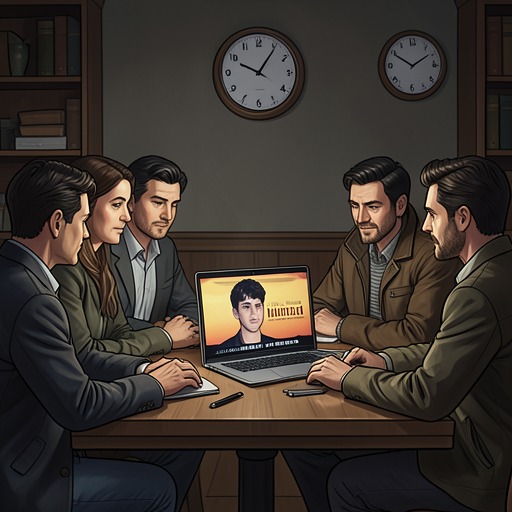
A few days after Spencer Hill died, his classmates created the page at www.myspace.com/Spencerhillmemorial. Its default-picture space contained a graphic of a flickering candle, giving the site the recognizable language of an online memorial. Spencer’s favorite song, “Broken Radio” by Jesse Malin with Bruce Springsteen, played on the page. Beside the candle appeared the lyric “The angels love you more than you know.” Music, image, and words made the site more than a collection of notices: it presented a composed tribute that visitors could return to and share.
The page also gathered photographs and comments, while a slideshow arranged images of Spencer Hill across different years. Some showed his childhood at Hillside Elementary School, including class pictures from first, third, and fourth grade. Another captured the victory of his intramural homeroom basketball team. In that photograph, Spencer held up the hand whose wrist Betsy had wrapped after a sprain before the game. The detail gives the archive an intimacy that the general memorial messages often lack: the image preserves an ordinary family memory alongside the public emblem of the candle.
Betsy’s Returns to the Page
In the days after Spencer’s death, Betsy spent most nights moving through the memorial. She read comments from children she had never known and looked at photographs of her son at different ages. This repeated use offered a way to encounter Spencer through the images and words left behind; it did not make the loss remote or resolved. Rather, the page became part of the private routine of her grief.
Over time, the comments began to feel hollow to her. Betsy judged that some of the popular girls who had created the page had scarcely given Spencer attention while he was alive, even as they now presented themselves as mourners. Their claims to miss him struck her as arriving too late. The memorial’s public display therefore unsettled rather than simply comforted her: it seemed to turn a particular boy into a convenient occasion for visible grief.
She noticed, too, how little appeared from Spencer’s close friends, including Clark, Adam, and Olivia. Betsy considered that absence against the possibility that people who truly grieve do not necessarily do so in public. By then she had not checked the site for three weeks, and there had been little new activity. The classmates’ attention had moved on, as she thought young people’s attention would. The difference between the page’s initial activity and its later quiet made the online memorial feel temporary, even as Betsy’s attachment to the photographs endured.
The Slideshow and the Photograph
The slideshow gave the page a motion different from the stillness of its candle and comments. Photographs rotated into view, paused, and were followed by others that seemed to pile over them. As Betsy watched, the succession of images stirred memories of Spencer’s life in concrete detail, including his excitement over the basketball victory and the wrist she had wrapped for him. A photograph could thus be both a fragment of family history and part of a sequence whose next image Betsy could not predict.
One image appeared and vanished before she could properly take it in. Betsy reacted with shock and tried to recover it from the passing slideshow. When she returned to the site and opened the slideshow, it redirected her to slide.com and demanded a password. She reasoned that students setting up the rotation would likely have chosen something simple, then entered SPENCER. The page’s structure—photographs moving through a shared online archive—had made the image fleeting; the password-protected slideshow made finding it again an act of deliberate investigation.
The photograph’s importance becomes clear in Betsy’s later confrontation with Adam. She holds up the picture from the MySpace page while he looks down, then thrusts it toward him when he looks up. Asked what happened, Adam says he was not there. The available account does not describe the photograph’s contents, but it establishes its consequence: an item first encountered among memorial images becomes evidence Betsy places before someone connected to Spencer’s story. The page has shifted from a place of remembrance into a means of asking what the remembrance cannot answer.
Remembrance and the Search for Truth
The page does not bring Betsy closer to a simple conclusion about grief. Its crowded slideshow keeps Spencer’s past visibly present, while its dwindling comments expose how quickly public attention can fade. At the same time, the image that interrupts the sequence resists being absorbed into a tribute. It prompts Betsy to look again and to confront Adam, changing the page’s role without erasing its original one.
That movement continues alongside Betsy’s efforts to understand the night Spencer died. In Spencer’s room, she holds his old cell phone, its battery long dead, and remembers how she stopped Ron from packing the room away. She tells Ron that she needs to find out what really happened that night, while acknowledging that the truth will not bring Spencer back or necessarily make them feel better. Later, Adam tells Betsy that he saw her and his mother on the roof and apologizes. These moments place the memorial page within a wider struggle to keep a relationship with Spencer while facing the unanswered circumstances of his death. Its photographs preserve a son who lived; one of them also makes it harder for the survivors to leave the questions surrounding his final night untouched.